Text By Lauren Brown Photos By Anjuli Bhattacharyya
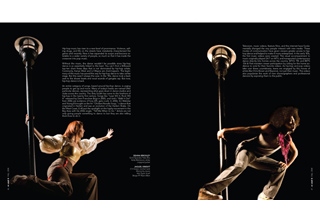
Featured Performers: Lina Kent Halley Willcox Jesse Wintermute
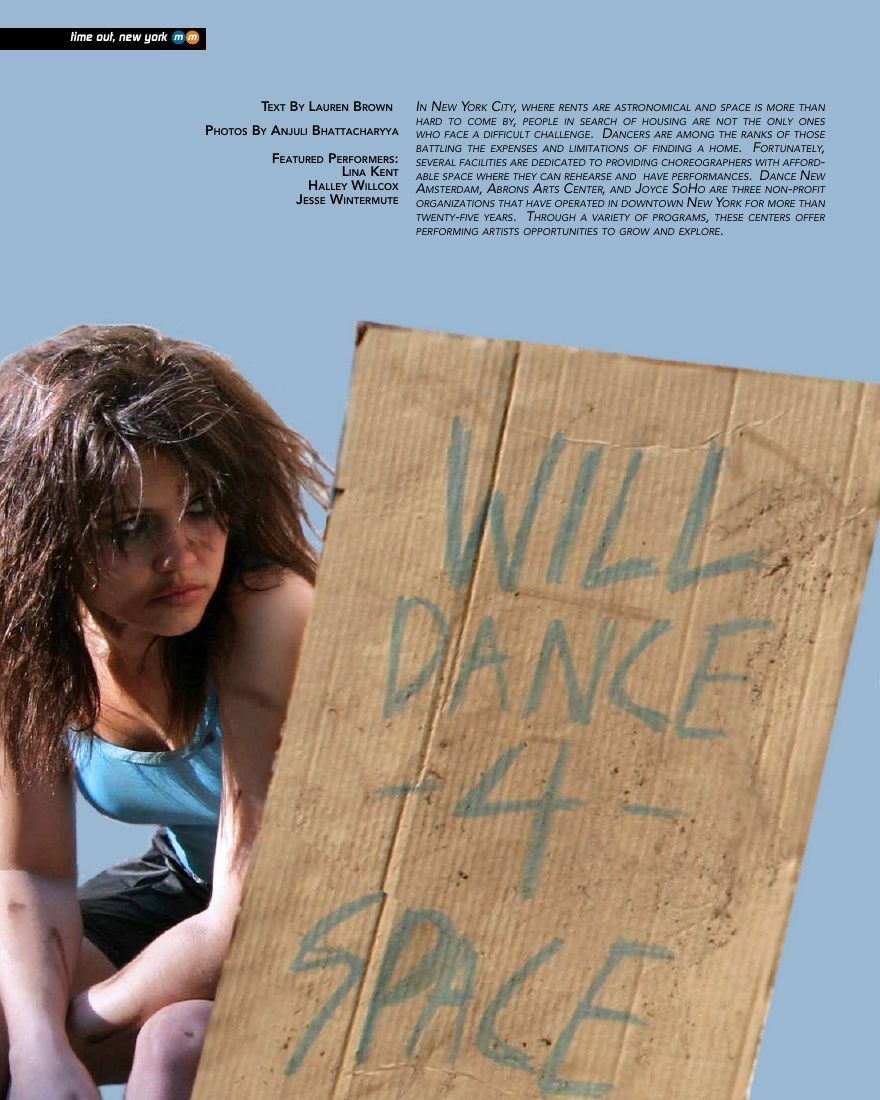
In New York City, where rents are astronomical and space is more than hard to come by, people in search of housing are not the only ones who face a difficult challenge. Dancers are among the ranks of those battling the expenses and limitations of finding a home. Fortunately, several facilities are dedicated to providing choreographers with affordable space where they can rehearse and have performances. Dance New Amsterdam, Abrons Arts Center, and Joyce SoHo are three non-profit organizations that have operated in downtown New York for more than twenty-five years. Through a variety of programs, these centers offer performing artists opportunities to grow and explore.
Joyce Soho 155 Mercer St New York, NY 10012 (212) 431-9233 Abrons Art Center 466 Grand St New York, NY 10002 (212) 598-0400
Dance New Amsterdam 280 Broadway # 2 New York, NY 10007 (212) 625-8369 hat used to be Dance Space Center is now Dance New Amsterdam, a hybrid organization that offers classes, workshops, studio time, and performance space to aspiring artists. Walking through the bi-level center presents activity around every corner: dancers line the hallways stretching before class, an artist perches in the back of the theater sketching forms of dancers, and a cat meanders through the administrative offices as if it were her home. “People are given the freedom to try something new, even if they’re young, it’s the same, safe place,” says DNA’s Executive Director Catherine Peila. Emerging choreographers have the opportunity to rehearse and hold showings, work with a mentor, and receive audience feedback so they can fine tune their craft. High ceilings create a sense of openness on the two levels, which are utilized for a myriad of artistic endeavors. The upstairs holds a visual arts gallery, and there are plans to transform the downstairs lobby into a cabaret area. DNA hopes to outfit their facility with plasma TVs that will be used to show streaming video and train artists in new media. The space has been a bastion to dancers in Lower Manhattan for years, helping to launch the careers of Arthur Aviles, Mark Davis, Joy Kellman, Jennifer Lambert, Lisa Race, and Kevin Wynn, just to name a few.
Part of DNA’s longevity and success comes from its belief in staying grounded in the community. Neighborhood restaurants and cafes are encouraged to participate in gallery showings while, in turn, they provide DNA students with discounts and free coffee. These strong ties have helped the center become a local fixture. But as rents continue to skyrocket, DNA struggles to stay afloat. The organization forges ahead using every resource it can in order to keep dance alive. Just recently, they had to start renting out space to Pace University and move some of their classes off site. Always in the midst of a juggling act, the center has extended its hours to offer additional studio time to artists developing their dance companies. “It’s not healthy for a government not to support its culture,” Peila says. Luckily, places like DNA have persevered so that experimental dance can continue to thrive. The Henry Street Settlement has been around for more than a century, offering New Yorkers a variety of social services in addition to a multidisciplinary arts program that is run at the Abrons Arts Center. Rich with history, Abrons’ intimate theater, the Playhouse, was designed in 1915 and maintains its original neo-classical style. Once
Space isn’t just a a precious commodity to dancers, though; it’s equally important to choreographers who are starting out, and those who have been around for years. Abrons recently turned an idle space into an experimental theater, which is now home to the Artist Workspace program. Artistic Director Jay Wegman explains, “The reason we’re doing this is that the space wasn’t being used, and artists needed it. There were a lot of artists midcareer who still need space,” like Karole Armitage, who has her own company and has toured all over the world as a dancer and choreographer. She’ll be visiting Henry Street as a Workspace Artist where she will rehearse, show her work, and instruct the Abrons’ dance ensembles. Today, boundaries are being crossed between what is dance and theater, traditional and experimental. The Artist Workspace program is open to any performing artist that needs the space. With many theaters closing and arts funding cut, there are plenty of performers without a home. The center’s philosophy demonstrates a flexibility and eagerness to provide for working artists. When it comes down to it, “if somebody has an idea, we’re willing to work with them,” says Catanach, an 18-year veteran of Henry Street.
The center possesses a warmth and energy that can only come from the pulse of creation. A partially exposed basement is filled with giant relief sculptures, as well as paint, debris, and the hum of resident artists at work. A storage room bursts at the seams with original period costumes ready to make their appearance onstage. The Director of Performing Arts Training, Daniel Catanach, takes time to ask teenage members of the Junior Ensemble about their latest rehearsal and also jokes with them about their latest crushes. The red brick complex is old, but still hip; recently, the television show Gossip Girl filmed at the center, and used the Playhouse as its auditorium. Capezio, a popular dancewear company, held a photo shoot in the studios for their entire catalog one year. Though they are small, both studios have huge windows that allow light to stream in and reflect off mirrored walls, making them optimal spaces for dancers to rent.
the mecca of the downtown arts scene, the stage was the site of Paul Taylor’s choreographic debut in 1954. John Cage, Aaron Copland, Dizzy Gillespie, Martha Graham, Alicia Keys, Alwin Nikolais, Jackson Pollack, Denzel Washington, Eartha Kitt, and Orson Welles have all trained, taught, or performed for Henry Street.
In the mid-’90s, the Joyce Organization met artists’ overwhelming need for affordable rehearsal and performance space by creating Joyce SoHo. The building is entirely devoted to this end; for twelve hours a day, seven days a week, three spaces are available for rent. Emerging choreographers and smaller dance companies generally monopolize the offerings. Program Manager Cathy Eilers acknowledges that “space is really hard to come by in New York...we’re pretty much full almost 100% of the time, so there’s definitely a need.” From the street, you would never know that this three-story former firehouse is home to one of the largest unobstructed dance studios in New York City. The massive space on the top floor of Joyce SoHo is absent of any columns or structural supports that can impede a space. Eleven years ago, the organization wanted to start a residency program and received a grant to build another studio. The program hosts a wide array of artists ranging from Danish Dance Theater, Denmark’s largest modern dance company, to John Selya, who was nominated for a Tony Award in 2003 for his performance in the musical Movin’ Out. Once someone becomes involved in the Joyce Organization it is not uncommon for them to remain connected. Camille A. Brown, an accomplished dancer, teacher, and choreographer, performed at Joyce SoHo in 2006 and is returning this June. “The first time I presented at Joyce SoHo I had ideas and now I feel like I’m coming to it differently, with full sentences and full stories,” she says. Brown’s work has been commissioned by Alvin Ailey American Dance Theater, Ballet Memphis, and Urban Bush Women. Institutions like Joyce SoHo have fundamentally helped her along the way. “There are so many of us that are looking for space and that support,” she says. “And when you do have it, it’s the type of thing . . . you don’t want to let go.” Each organization provides emerging artists with their own space and continues to foster experimentation. Despite poor funding, high rents, and a gloomy economic climate, DNA, Abrons Arts Center, and Joyce SoHo have endured. More than just physical space, these sites provide the artistic and professional support that dancers and choreographers need to keep doing what they do: creating and expressing through movement. LB dnadance.org joyce.org henrystreet.org/arts camilleabrown.org