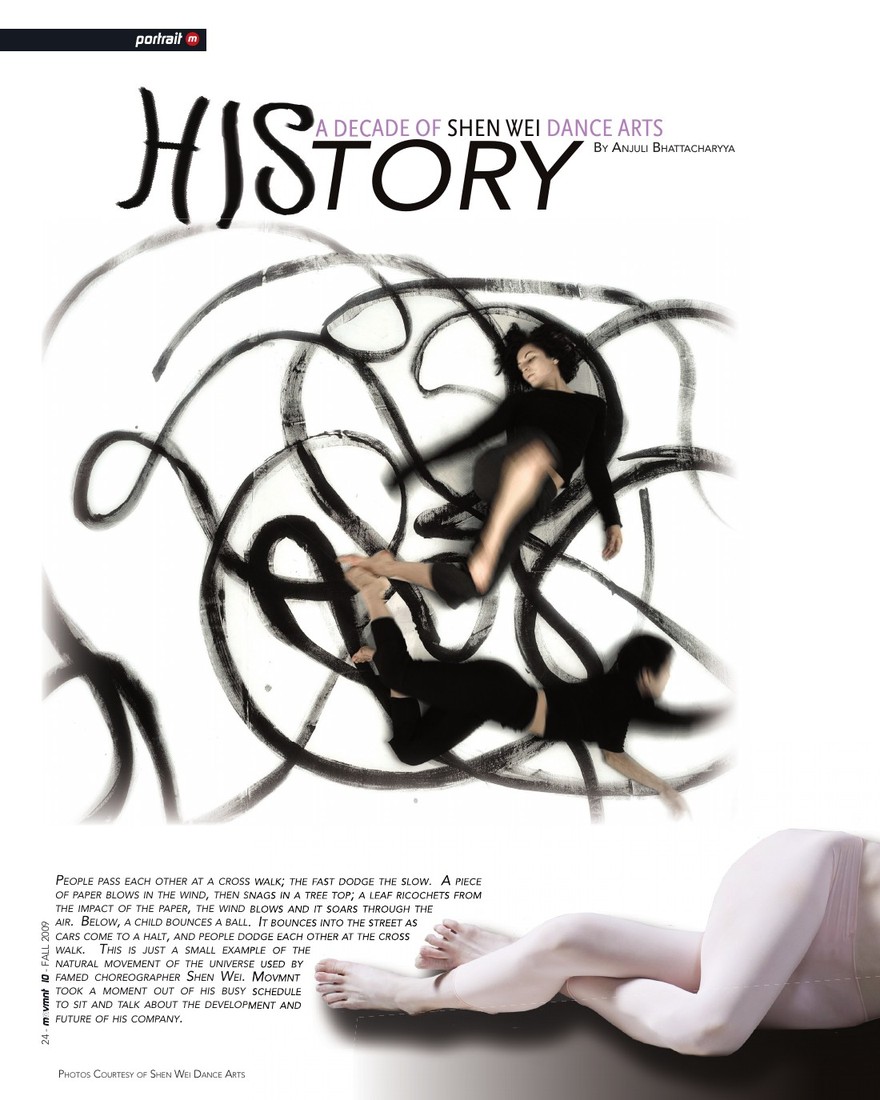
People pass each other at a cross walk; the fast dodge the slow. A piece of paper blows in the wind, then snags in a tree top; a leaf ricochets from the impact of the paper, the wind blows and it soars through the air. Below, a child bounces a ball. It bounces into the street as cars come to a halt, and people dodge each other at the cross walk. This is just a small example of the natural movement of the universe used by famed choreographer Shen Wei. Movmnt took a moment out of his busy schedule to sit and talk about the development and future of his company.
Photos courtesy of Shen Wei Dance Arts
Shen Wei, a native of Hunan, China, is an internationally renowned choreographer, visual artist, photographer, and designer. His company, Shen Wei Dance Arts, exists around the idea of a transcendental movement quality, dubbed the Natural Body Development technique, the basis of which is the choreographer’s innate ability to perceive the world as one huge dance. He incorporates natural movement from the way a ball bounces, to the way a body internally rotates upon each vertebrae. His instinctive ability to capture minute detail is why each piece he creates becomes its own unique language. Shen Wei Dance Arts (SWDA) was founded in 2000, at the American Dance Festival in Durham, NC. During the inception of the company, Wei created two new works, Folding and Near the Terrace (Part 1). “When I started the movement for my first pieces, the focus was on learning about the quality of movement and your body,” Wei says. “The works were slower; not fancy. I started with a limited vocabulary of movement.”
“In 2002 and 2003, while I was creating Rite of Spring, the company took a big step because I was able to take the time to develop more physically challenging movement,” Wei explains. Rite of Spring, a play on Nijinsky’s famous ballet, incorporates complex and dynamic movement, while all other elements are very minimal: simple lighting, muted costumes, and few exits and entrances. Wei does not just set movement on his dancers, but rather uses movement that comes naturally to their bodies — stemming from the Natural Body Development technique classes and their improvisation. “The best time we have is in rehearsals; it’s like being inside of a movement laboratory,” Sarah Procopio, a founding member of SWDA, says of developing new dances. “Shen calls it ‘going shopping’,” she explains, laughing. “I tell the dancers to try on movement, but when you are shopping, try to find the expensive, delicious, and most tasteful... the luxurious stuff,” Wei interjects.
Each piece Wei creates has its own specific movement vocabulary, but they all stem from the Natural Body Development. This use of a conceptually specific technique, he says, has helped both him and the dancers connect and identify with each piece independently.
With the acclaim gathered from Folding, a surreal architectural and operatic performance one might associate with scenes from a wuxia film like House of Flying Daggers or Crouching Tiger, Hidden Dragon, Wei was able to propel his company forward and further develop his technique.
In 2005, the choreographer wanted to start a more abstract piece, both physically and dimensionally, by incorporating traditional and multimedia art forms. Coming from a family of Chinese Opera professionals, where art forms were never thought of as separate entities, Wei longed for a way to communicate them in one piece. From this desire came SWDA’s next two pieces, Connect Transfer and Map. Connect Transfer features dancers adorned with paint-dripping socks on their hands and feet, as they seamlessly glide over a canvased floor. By the end of the piece, the swirls, slips, and slides, all come through as strokes on the gigantic canvas (which afterwards is cut into pieces and sold to audience members); a visual masterpiece that unfolds in front of your eyes. Portions of Connect Transfer were seen in the 2008 Beijing Olympic’s grand arena during the dazzling Opening Ceremonies.
Inspired by trips to the far east, Shen Wei recently revealed REParts I, II and III, a journey through some of the world’s most mysterious societies: Tibet, Angkor Wat, and The Silk Road. The prefix “re” is meant to invoke concepts like renew, rediscover, and repair, visualized in the piece by the use of found materials and photography from the jungles, deserts, and cities he encountered. “I can use words to express anything I want, but I wanted to use movement and dance to explain complicated issues, because movement is really so pure,” Wei expresses.
A master craftsman in the world of dance, Shen Wei is on his way to becoming the next dance great with his ingenious choreography and insight into human movement. “It’s been an incredible journey over the past ten years. I have learned about myself and grown as a dancer through working with Shen in the studio and in performances. He really is incredible,” Procopio remarks. SWDA members will soon be teaching Shen Wei’s Natural Body Development technique in Universities and studios throughout the world (starting in Milan, Italy), furthering his legitimacy in the dance world. “Finally, after these past ten years, I feel more grounded and more comfortable with challenging myself,” Wei says of his role as a choreographer. “I’ve finally found a stable place.”
Who would you say is the most influential choreographer in your life?
I go see every choreographer’s work, to see the possibilities. Everyone influences me. If you go to a show and see one thing that really belongs to that choreographer, then I really appreciate that. I’m not excited by flashy lights, just by originality and natural creativity.