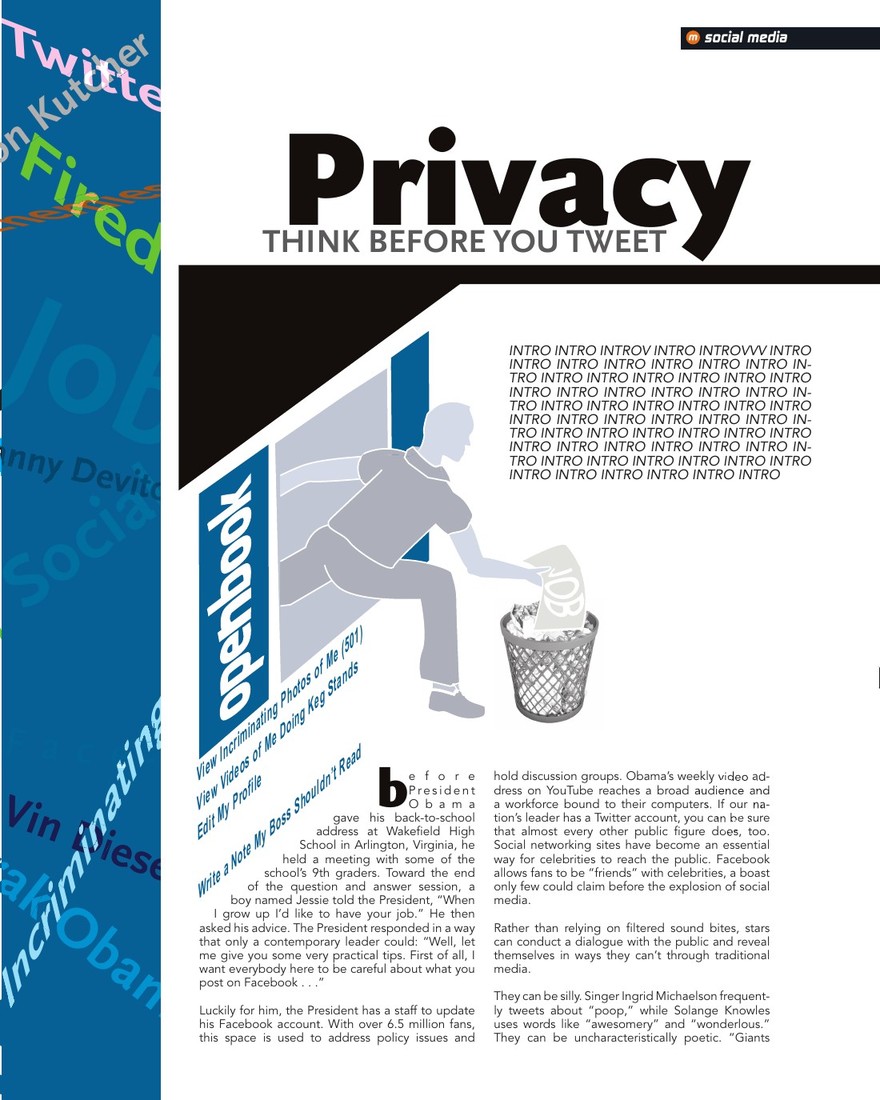
Before President Obama gave his back-to-school address at Wakefield High School in Arlington, Virginia, he held a meeting with some of the school’s 9th graders. Toward the end of the question and answer session, a boy named Jessie told the President, “When I grow up I’d like to have your job.” He then asked his advice. The President responded in a way that only a contemporary leader could: “Well, let me give you some very practical tips. First of all, I want everybody here to be careful about what you post on Facebook . . .” Luckily for him, the President has a staff to update his Facebook account. With over 6.5 million fans, this space is used to address policy issues and hold discussion groups. Obama’s weekly video address on YouTube reaches a broad audience and a workforce bound to their computers. If our nation’s leader has a Twitter account, you can be sure that almost every other public figure does, too. Social networking sites have become an essential way for celebrities to reach the public. Facebook allows fans to be “friends” with celebrities, a boast only few could claim before the explosion of social media. Rather than relying on filtered sound bites, stars can conduct a dialogue with the public and reveal themselves in ways they can’t through traditional media.
They can be silly. Singer Ingrid Michaelson frequently tweets about “poop,” while Solange Knowles uses words like “awesomery” and “wonderlous.” They can be uncharacteristically poetic. “Giants […] Sex lost... But the city Won!!! It’s a gorgeous nite in SF, 77 degrees with a smooth gentle breeze...” tweets MC Hammer.
They can be real. On Facebook, Vin Diesel posted a photo of a lunch meeting with his father, along with some of the advice he received from his dad: “Confidence is the most important thing you can teach someone... if you can teach them confidence, you don’t have to teach them anything else.”
Sometimes celebrities can share too much. Ashton Kutcher posted a picture of his wife Demi Moore’s bare derriere on Twitter while Moore once posted a photo of herself after dental surgery missing a front tooth. Lindsay Lohan often tweets at a frenetic minute-to-minute pace, sharing rants directed at her sometimes girlfriend, Samantha Ronson. Suffice it to say, a celebrity “speaking” for himself can be a publicist’s nightmare. YouTube has captured videos of Danny DeVito and David Hasselhoff drunk. Footage of Fergie onstage with unsightly wet spots or Beyoncè tumbling down the stairs at a performance make it hard to keep embarrassing moments under wraps.
Beyond the nipple slips and nose picks, the use of social media raises a host of ethical issues. Twitter can feel like a collective toilet of verbal diarrhea; you’re talking to both everyone and no one. But what you say is immutably “on the record.” ABC News Anchor Terry Moran caused quite a stir when he tweeted, “Pres. Obama just called Kanye West a ‘jackass’ for his outburst at VMAs when Taylor Swift won. Now THAT’S presidential.” Only, Obama was off the record. Abiding by professional codes of conduct is even more paramount in a world where breaches of confidentiality can be broadcast at the speed of light. Daryl Eisenberg, the casting director for The Gay Bride of Frankenstein, had the theater world abuzz when she tweeted snide comments about actors during their auditions: “If we wanted to hear it a different way, don’t worry, we’ll ask,” and, “Your skirt makes me think you’re Wiccan...” Anticipating a backlash, Eisenberg defended her on-thejob tweeting: “There is NO rule/guideline against Twitter/Facebook/MySpace/Friendster. Freedom of speech. Ever heard of it?” Professional integrity. Ever heard of it? She later apologized and met with the Actors’ Equity to discuss Twitter’s appropriate place in the industry.
While stars revel in this new form of round-the-clock publicity, some are wary of how far their private lives can be invaded. Denise Richards says paparazzi check her Twitter account and follow her to the hair salon. If you don’t want people following you offline, you probably shouldn’t disclose your whereabouts online. In May, it was reported that Twitter co-founders Evan Williams and Biz Stone had a soft agreement with Reveille and Brillstein Entertainment Partners to produce a Twitter-based TV show. The show’s premise would feature contestants trailing celebrities. Ashton and Demi threatened to stop tweeting. Reportedly, the show is still going on, but Twitter officials have distanced themselves.
Michael J. Carrasquillo, 32, Founder of NYC Media Makers and the 2009 President of Podcamp NYC Chapter, advises that people use common sense when it comes to social networking. He says, “don’t put everything out there. Remember, once it’s on-line, IT’S ONLINE! Even if you’re blocking it or making the media you’ve uploaded private, it exists in the limbo of the net. So I’d advise someone, never put anything up there that you don’t want to answer to in a court of law someday.”
The fallout of the social media explosion requires users, celebrities, and fans alike, to be more responsible. Everyone is susceptible to scams and following false accounts. Barack Obama and Britney Spears were among the many users to have their Twitter accounts hacked. Lawsuits over libelous tweets and fake Facebook profiles are popping up across the country. It’s up to Facebook and Twitter to keep their networks secure, but we can do our part by thinking before we tweet.