The ‘40s – ‘80s | Bugs gone wild
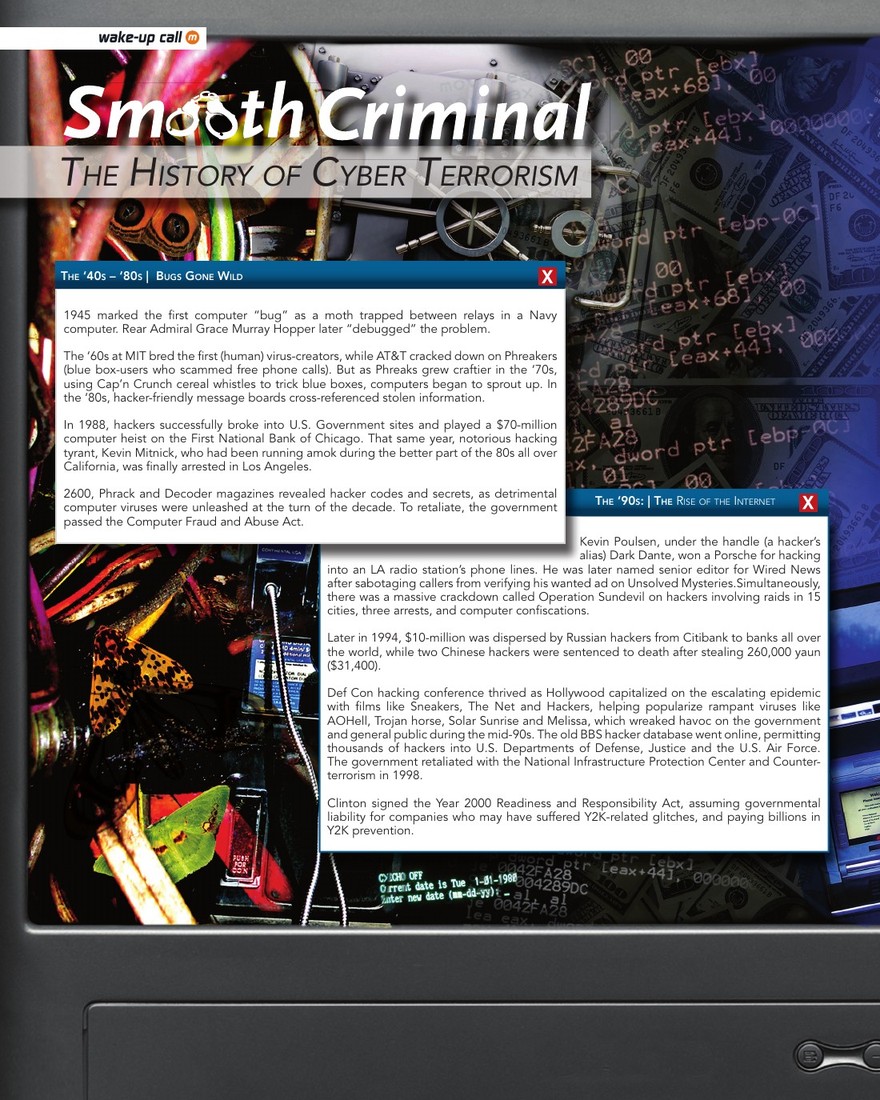
1945 marked the first computer “bug” as a moth trapped between relays in a Navy computer. Rear Admiral Grace Murray Hopper later “debugged” the problem. The ‘60s at MIT bred the first (human) virus-creators, while AT&T cracked down on Phreakers (blue box-users who scammed free phone calls). But as Phreaks grew craftier in the ‘70s, using Cap’n Crunch cereal whistles to trick blue boxes, computers began to sprout up. In the ‘80s, hacker-friendly message boards cross-referenced stolen information. In 1988, hackers successfully broke into U.S. Government sites and played a $70-million computer heist on the First National Bank of Chicago. That same year, notorious hacking tyrant, Kevin Mitnick, who had been running amok during the better part of the 80s all over California, was finally arrested in Los Angeles. 2600, Phrack and Decoder magazines revealed hacker codes and secrets, as detrimental computer viruses were unleashed at the turn of the decade. To retaliate, the government passed the Computer Fraud and Abuse Act.
The ‘90s | The rise of the internet
Kevin Poulsen, under the handle (a hacker’s alias) Dark Dante, won a Porsche for hacking into an LA radio station’s phone lines. He was later named senior editor for Wired News after sabotaging callers from verifying his wanted ad on Unsolved Mysteries.Simultaneously, there was a massive crackdown called Operation Sundevil on hackers involving raids in 15 cities, three arrests, and computer confiscations. Later in 1994, $10-million was dispersed by Russian hackers from Citibank to banks all over the world, while two Chinese hackers were sentenced to death after stealing 260,000 yaun ($31,400). Def Con hacking conference thrived as Hollywood capitalized on the escalating epidemic with films like Sneakers, The Net and Hackers, helping popularize rampant viruses like AOHell, Trojan horse, Solar Sunrise and Melissa, which wreaked havoc on the government and general public during the mid-90s. The old BBS hacker database went online, permitting thousands of hackers into U.S. Departments of Defense, Justice and the U.S. Air Force. The government retaliated with the National Infrastructure Protection Center and Counterterrorism in 1998.
Clinton signed the Year 2000 Readiness and Responsibility Act, assuming governmental liability for companies who may have suffered Y2K-related glitches, and paying billions in Y2K prevention.
The early millennial | Hackers turned terrorists
Amazon, Buy.com, CNN, Datek, eBay, E*Trade, Yahoo and ZDNet sites were victims of distributed denial-of-service (DDoS) attacks, being kicked offline for hours while a flood of traffic from hundreds of computers hit them simultaneously at the turn of the century. Sophisticated and detrimental viruses started popping up like LoveLetter, Code Red, Nimda, Anna Kournikova and Slammer, causing cash machine failures, delay in airline flights, governmental snags, computer crashes and monetary loss within a few hours. Kevin Mitnick, a jail-hopping hacker and fugitive of the nineties, was released from prison, while the first person to defy the Digital Millennium Copyright Act (DMCA), Dmitry Sklyarov, was arrested at a Def Con convention. The government saw cyberspace as a “direct instrument of bloodshed” (the Washington Post, 2002) in lieu of the World Trade Center attacks, so the Department of Homeland Security was created to help counter unruly web terrorists. Near the mid-thousands, an upsurge in credit card theft and fraud grew immensely.
The late millennial | Can hackers take down a nation?
The world’s first cell phone virus was Commwarrior-A. It paved the way for more advanced cell phone viruses beyond 2005. Shortly after, the Department Of Defense attributed the People’s Liberation Army of China with the “most successful cyber attack against the US defense department,” (Financial Times, 2007) causing over 1,500 Pentagon employees’ computer systems to go offline for an entire week. Meanwhile, hackers from Germany stole $6-million from banks in Spain, Italy, the UK and the US using an intelligent hacking program called ZeuS. The Conficker virus in 2008 was thought to be the largest worm since the Slammer five years prior, infecting millions of government organizations worldwide and rooting at least five variations of itself to fight antivirus efforts.
Later the same year, and only hours after a Russian military invasion into Georgia, came a debilitating cyberattack that took out 20 of its government, bank and media sites for over a week. Estonia experienced a similar attack at the same time.
The present | Government fights back
Early this year, massive Palestinian attacks have been suspected upon hundreds of Israeli social networking sites containing underground Islamist communities worldwide. A few months later, the White House, Federal Trade Commission, and the Departments of Transportation and Treasury sites in South Korea and the US have had multiple coordinated DDoS attacks from anywhere between 20,000 – 166,000 random botnets (hijacked computers in large quantities). Within months of these attacks, another DDoS hit the Washington Post and New York Stock Exchange. Twitter and Facebook were completely shut down for several hours, denying service to millions of users around the world. In late summer, Asperger’s syndrome (a form of autism that leaves people vulnerable to changes in their environment) hacker, Gary McKinnon, was charged with breaking into nearly 20 military and six NASA facilities, installing software and deleting files that caused roughly $600,000 in irreparable damage.
In September 2010, the Homeland Security Department’s Cyber Storm III will provide efficient and safer methods of information sharing while defining roles and responsibilities through administrators monitoring Internet safety, harmonizing threat languages between the government and private sectors. An in-depth report on Cyber Storm III will be released in November.