Story by Simone Maurice. Photos by Dave Hill.
Imagine witnessing the torch of creative genius travel down the yellow brick road of pop music history first hand with Michael Jackson. Through his legacy of pioneering performances — decades worth of footage transmitted around the world — future generations will be able to witness his magic even though he’s no longer with us. Within the following pages, experience true tales through the eyes of those who walked the winding road with the innovative movement master himself.
“The Michael Jackson experience,” says choreographer and director Travis Payne, “[is] very much like an [institution] where it’s about entertainment value and purpose.” Michael’s creative process set the standard for choreographing one’s own legacy while moving generations of audiences through the power of music and dance. “[The choreographic process] was as much an obvious thing as [it was] subliminal,” says Payne. “First it would begin with listening to the music, then we would write a word — sometimes a phrase — and take those emotional bullet points and start to play.”
When sorting through the various options created while choreographing with the star, it was often difficult to decide which was the best. “If you’re in tune with the body of work, what’s going on at that very moment, what exactly you are choreographing for — the piece, music, and what you’re trying to portray — then what comes out of you is you,” says Tony Testa. “You have to feel it, and once you can feel it, all of the synergy around what you are trying to create is in place.” It was an intense and rigorous process driven by emotion, tone, texture and structure. “[Finding] the best parts from each of those options [was] probably very close to compositing a vocal track or a piece of film,” says Payne. “Meanwhile, you keep the other pieces because they came through the process and may speak to you in another location in the song, an entirely different song, or in another project.”
For example, “Billie Jean” took 91 mixes to create, and in the end Jackson chose the second version to make the cut for the record-setting album Thriller, according to recording engineer and producer, Bruce Swedien. “Quincy [Jones] said to listen to one of the earlier mixes and see if we actually improved the song,” says Swedien.“ So I played mix two and it was absolutely incredible. It just blew us away, so that’s the mix that went on the record.”
Jackson’s approach to creating art was the idea of allowing it to create itself. His introspective creative process shines through even in today’s society. “It always makes me think twice about where the movement’s coming from. It can’t come from insecurity, you have to believe in what you’re doing and the movements that come out will be amazing,” says Testa on being influenced by Michael’s process while working as an assistant choreographer on the This Is It tour. “Even on a subliminal level [the] audience can recognize the cohesion with the rest of the show if everything fits.”
Without intention, Wade Robson’s Zombie dance to Roisin Murphy’s “Ramalama (Bang Bang)” for So You Think You Can Dance two years ago, much resembled “Thriller.” Jackson’s work has evolved in our pop psyche from casual entertainment to its own dance genre. Travis Wall, another up-and-coming choreographer who’s been influenced by Jackson and who the pop master worked with, agrees that Robson is the frontrunner in carrying on MJ’s dance legacy to future generations. He says that the pop star’s dancing lives through Robson’s moves. Wall’s collaboration with Robson on the upcoming feature film remake of Footloose was strongly inspired by Michael. “I was such a huge fan of [Michael],” he says. “I just did my own thing to his music.”
According to Tony Testa, instinctual drive is what fueled Michael’s creative spirit. “When I watch guys [like Kenny Ortega, and Travis Payne] work, it is balls-to-the-wall so to speak. It comes from a place where you believe, from your bones.” As an audience, we only get to scratch the surface of the meaning behind the movements, while Michael’s benefactors lived the experience. “When I was little, I would constantly choreograph to ‘Bad’, ‘Beat It’, and ‘Man in the Mirror’,” says Wall. Trailblazing choreographer and dancer, Brian Friedman shares a similar story: “Starting out as a kid with no dance training at all, my training was watching [Michael Jackson’s] videos and trying to emulate him. I had a sequined glove. I would put it on in my room and do everything Michael did in his videos.” Jackson’s legacy incorporates everything from small idiosyncrasies like the vibrato in his voice, to his stealth dancing, to his kindhearted nature, his ability to be humble and make fun of himself, to the way he was always on the top of the trends in technology and producing. Everything that he was as a person-- and lacked as a person (a proper childhood, freedom from the press, a sense of normalcy, etc.) funneled itself into his art. “Some people get their inspiration from movement, food, friends, animals, and things that are around them in life,” says Friedman. “I draw inspiration from work that comes before me. Michael Jackson is beyond the top of my list.” Michael’s moves and philosophies spanned to the far reaches of global audiences, crossing genres and shocking the world while paving the way for future artists.
“He made it okay to dance,” says Friedman. “I was growing up in a time when there weren’t a lot of male role models in dance. It was Michael Jackson and that was pretty much it!”
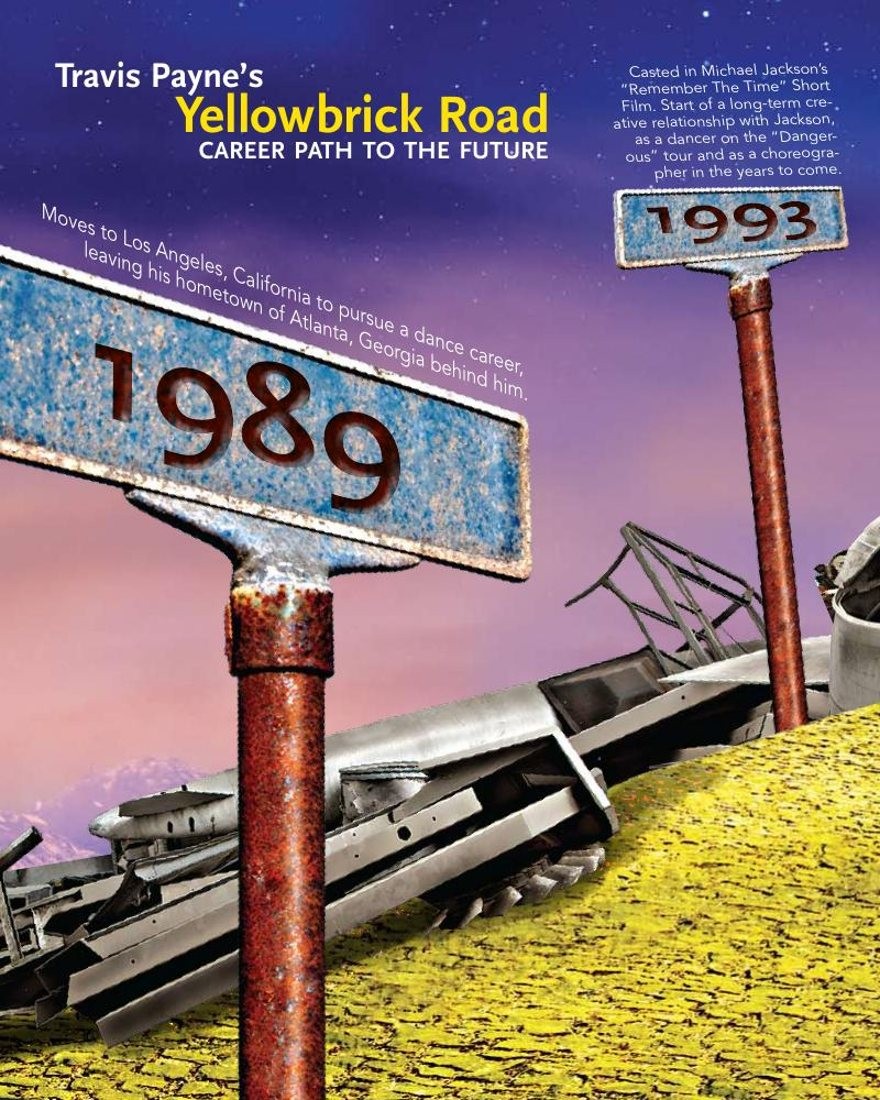
In 1983, Michael performed “Billie Jean” on the televised special, Motown 25: Yesterday, Today, Forever. That performance marked a defining moment in his career, and introduced international audiences to his dazzling new dance style. Credit goes to Singer/Dancer/Musician Jeffrey Daniel and Geron “Casper” Candidate, who introduced Michael to the Moon-walk, Gliding, and Popping. But it wasn’t long until Jackson himself became the man others credited for their style. His own sister, Janet Jackson, drew upon his methods during her Rhythm Nation 1814 tour. Precision military-style dance numbers drew a direct correlation to Michael’s aesthetics. This tour was also the platform that launched Payne’s blossoming choreographic career, which included the “Remember The Time” video that would start a long-term creative relationship with Payne leading to the recent role of choreographing and associate directing the This is It tour.
“Early on, Michael Jackson introduced me to all the works of Bob Fosse,” says Payne. “We’d sit and study, listen and learn from some of his great works and especially how to film dance; how the emotion of it carries through in storytelling and how there can be more power in doing nothing than there can be in doing a whole series of steps if it’s in the right moment. It would become a very encompassing process.” There are virtually no artists presently able to match his massive range of talent while exemplifying a belief in the innate beauty of mankind through pop art. During the 2009 VMA’s, Madonna kept saying that although Michael was a king, he was first and foremost a human being. “He was other-worldly,” she noted. “A whole new generation of kids are discovering his genius and are bringing him to life again.” Even those who knew his work before his death feel connected in a new way. “All the work that I’ve put out since he passed away, I’ve really been a fan of,” says Friedman. “I think you have to have a clear vision and really stay true to it. Cherish who’s here, grow from what they’re giving us, and just really live in the day because you never know when it’s your last, and that’s the truth.”
Travis Wall, carrying on the legacy
“When I was little, I would constantly choreograph to ‘Bad’, ‘Beat It’, and ‘Man in the Mirror’. I’d always put those songs on and start dancing in the living room. I would choreograph little numbers for my mom and make her watch them. But for me, I would always choreograph to his music, I wouldn’t necessarily dance like him. I loved doing technical moves and dancing that way instead of dancing exactly like Michael. I studied his music. I was such a huge fan of his music and then just did my own thing to it. After all, music is the reason why I dance. I could never have silence and start moving; that’s not me.”