Hotel Chelsea, New York City wake up call
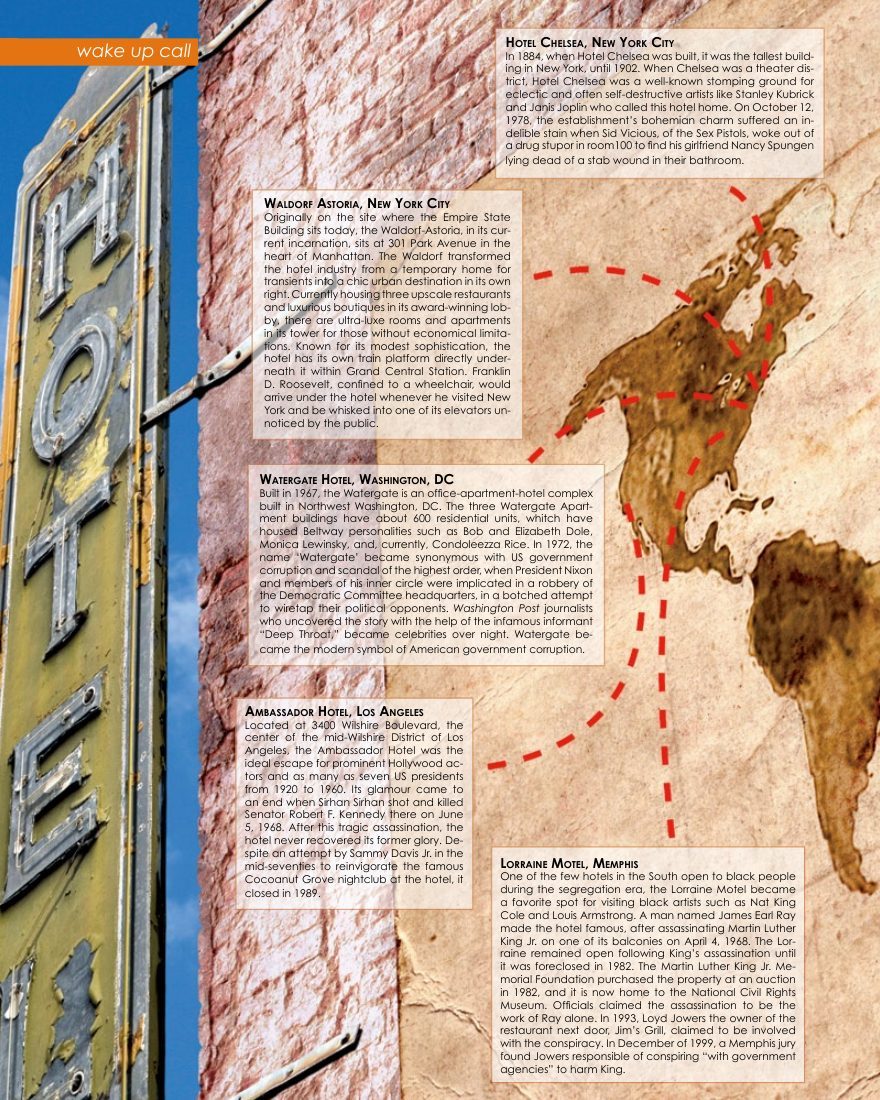
In 1884, when Hotel Chelsea was built, it was the tallest building in New York, until 1902. When Chelsea was a theater district, Hotel Chelsea was a well-known stomping ground for eclectic and often self-destructive artists like Stanley Kubrick and Janis Joplin who called this hotel home. On October 12, 1978, the establishment’s bohemian charm suffered an indelible stain when Sid Vicious, of the Sex Pistols, woke out of a drug stupor in room100 to find his girlfriend Nancy Spungen lying dead of a stab wound in their bathroom.
Waldorf Astoria, New York City
Originally on the site where the Empire State Building sits today, the Waldorf-Astoria, in its current incarnation, sits at 301 Park Avenue in the heart of Manhattan. The Waldorf transformed the hotel industry from a temporary home for transients into a chic urban destination in its own right. Currently housing three upscale restaurants and luxurious boutiques in its award-winning lobby, there are ultra-luxe rooms and apartments in its tower for those without economical limitations. Known for its modest sophistication, the hotel has its own train platform directly underneath it within Grand Central Station. Franklin D. Roosevelt, confined to a wheelchair, would arrive under the hotel whenever he visited New York and be whisked into one of its elevators unnoticed by the public.
Built in 1967, the Watergate is an office-apartment-hotel complex built in Northwest Washington, DC. The three Watergate Apartment buildings have about 600 residential units, whitch have housed Beltway personalities such as Bob and Elizabeth Dole, Monica Lewinsky, and, currently, Condoleezza Rice. In 1972, the name ‘Watergate’ became synonymous with US government corruption and scandal of the highest order, when President Nixon and members of his inner circle were implicated in a robbery of the Democratic Committee headquarters, in a botched attempt to wiretap their political opponents. Washington Post journalists who uncovered the story with the help of the infamous informant “Deep Throat,” became celebrities over night. Watergate became the modern symbol of American government corruption.
Located at 3400 Wilshire Boulevard, the center of the mid-Wilshire District of Los Angeles, the Ambassador Hotel was the ideal escape for prominent Hollywood actors and as many as seven US presidents from 1920 to 1960. Its glamour came to an end when Sirhan Sirhan shot and killed Senator Robert F. Kennedy there on June 5, 1968. After this tragic assassination, the hotel never recovered its former glory. Despite an attempt by Sammy Davis Jr. in the mid-seventies to reinvigorate the famous Cocoanut Grove nightclub at the hotel, it closed in 1989.
One of the few hotels in the South open to black people during the segregation era, the Lorraine Motel became a favorite spot for visiting black artists such as Nat King Cole and Louis Armstrong. A man named James Earl Ray made the hotel famous, after assassinating Martin Luther King Jr. on one of its balconies on April 4, 1968. The Lorraine remained open following King’s assassination until it was foreclosed in 1982. The Martin Luther King Jr. Memorial Foundation purchased the property at an auction in 1982, and it is now home to the National Civil Rights Museum. Officials claimed the assassination to be the work of Ray alone. In 1993, Loyd Jowers the owner of the restaurant next door, Jim’s Grill, claimed to be involved with the conspiracy. In December of 1999, a Memphis jury found Jowers responsible of conspiring “with government agencies” to harm King.
Built in 1910, the Hôtel Lutetia, in the heart of St. Germain des Prés district of Paris, is known both for its early Art Deco architecture as well as its pivotal role in the German occupation of France during World War II. Dignitaries and artists loved this Left Bank accommodation, and it became a refuge for artists and civilians in 1939 as the Germans swept through the countryside of France. Evacuated in 1940, when the Germans reigned over Paris for four years, it finally became a home base for French and American forces. In 1944, after Paris was liberated, it provided a sanctuary for prisoners of war and refugees from concentration camps.
Even famously reserved Japanese culture can’t stop the body rock, as evidenced by the existence of elaborate “love hotels” in Tokyo and Osaka, Japan. Young couples originally frequented these establishments, since many of them live with their parents. Often run by the Japanese mafia, love hotels are meant to give privacy for the night, maybe a few hours, to amorous companions. Some offer themed rooms that have a wide variety of recreational design elements such as bondage equipment or jungle gyms. Gang Snowman in Osaka is widely recognized as one of the most elaborate hotels of its kind, offering mini-jail cells, high-powered squirt guns and a full-sized Cadillac chassis on the roof deck for anyone to use.
Hôtel des Mille Collines, in the capital city of Kigali, comes from the French phrase, “des Mille Collines,” or “Land of a Thousand Hills,” a poetic name for Rwanda. In 1994, over a period of about one hundred days, Hutu militia groups brutally killed between 500,000 to 1,000,000 Tutsis, as well as moderate Hutu politicians in a genocide resulting from a brutal civil war between the ethnic groups. The hotel manager, Paul Rusesabagina, heroically hid and saved over 1,200 potential Tutsi victims at the hotel during the genocide.
Lately, the only sightseers in Baghdad seem to be war correspondents, so it makes sense that the Palestine Hotel, simply referred to as the Palestine, would find itself home to a swarm of media activity and high-profile Western journalists. An eighteen-story structure built in 1982 by French hotelier Le Méridien, the Palestine constantly rides a fine line between covering the news and being the news. In 2003, an American tank accidentally fired into the hotel, killing two cameramen and wounding three journalists. Subsequent to a truck bomb incident in 2005, many of the remaining journalists left the hotel for safer quarters in the Green Zone.
In 1931, the King David Hotel opened in Jerusalem, and soon lived up to its name by housing three monarchs in exile in its first decade. It was bombed in 1946 by a militant Zionist group called Irgun. Today Jewish retaliation against a British secretariat might seem absurd, but the political struggle of the Middle East has changed dramatically since the formation of the state of Israel. A that time, British rule was seen as an impediment to the Zionist cause. Even though the Brits were warned a half an hour before the bombing, they suffered casualties because they “don’t take orders from the Jews,” recalled Irgun’s leader Menahem Begin. He later became Israel’s Prime Minister.
Hi Desi gn ndr by A ew
- Te x an t by