Regina Spektor · Far
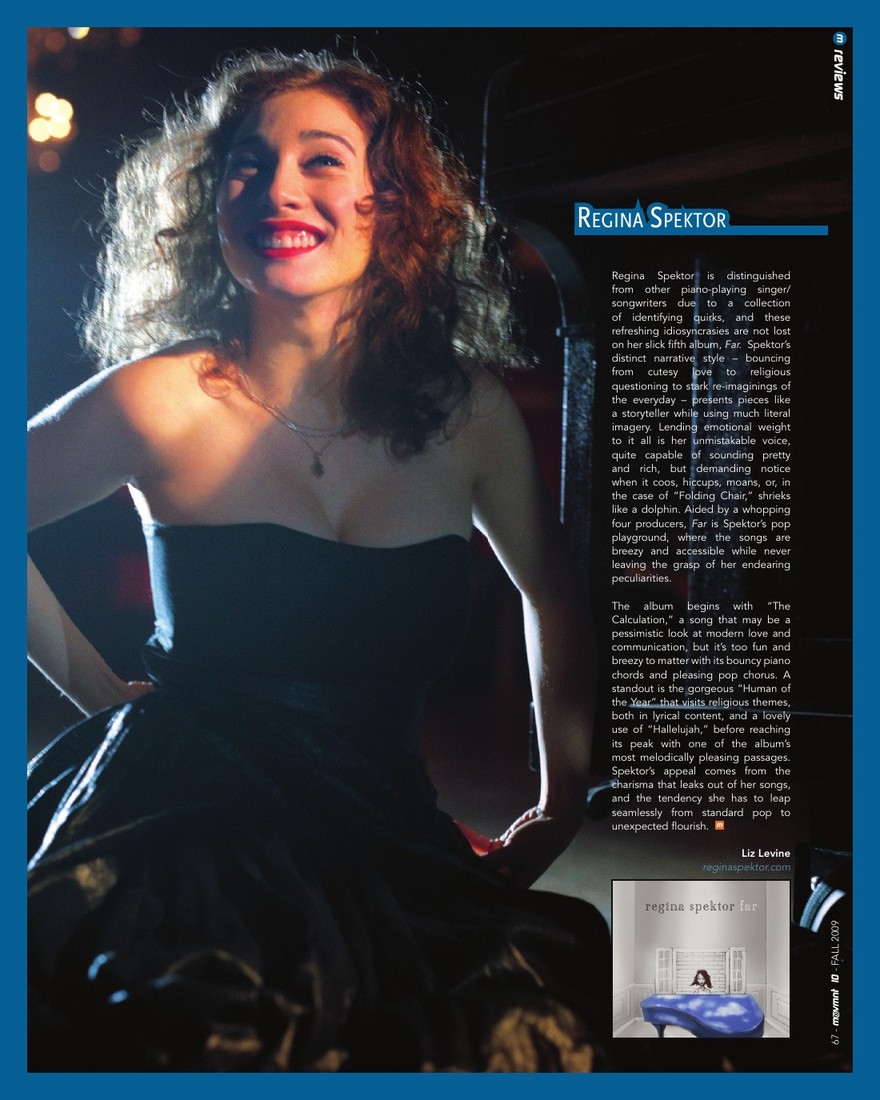
Regina Spektor is distinguished from other piano-playing singer/ songwriters due to a collection of identifying quirks, and these refreshing idiosyncrasies are not lost on her slick fifth album, Far. Spektor’s distinct narrative style – bouncing from cutesy love to religious questioning to stark re-imaginings of the everyday – presents pieces like a storyteller while using much literal imagery. Lending emotional weight to it all is her unmistakable voice, quite capable of sounding pretty and rich, but demanding notice when it coos, hiccups, moans, or, in the case of “Folding Chair,” shrieks like a dolphin. Aided by a whopping four producers, Far is Spektor’s pop playground, where the songs are breezy and accessible while never leaving the grasp of her endearing peculiarities. The album begins with “The Calculation,” a song that may be a pessimistic look at modern love and communication, but it’s too fun and breezy to matter with its bouncy piano chords and pleasing pop chorus. A standout is the gorgeous “Human of the Year” that visits religious themes, both in lyrical content, and a lovely use of “Hallelujah,” before reaching its peak with one of the album’s most melodically pleasing passages. Spektor’s appeal comes from the charisma that leaks out of her songs, and the tendency she has to leap seamlessly from standard pop to unexpected flourish. — Liz Levine
White Denim · Fits
Disjointed, disjunctive, and sublimely psychedelic, White Denim--the Austin, Texas trio--has built a heady reputation on the strength of blistering live performances and an acute unwillingness to settle on one sound, style, or genre, even within the parameters of a song. Shape shifting has always trumped fluidity for these boys, and in doing so, they have staked out a sound unlike any their current peers can muster. Instead, White Denim’s latest, Fits, finds its hip-shaking, bone-crunching grooves in the band’s brilliantly reconfigured version of the past. Think somewhere in between The Jimi Hendrix Experience and Captain Beefheart’s Trout Mask Replica era and you’re on the right track. “I Start to Run” rolls in on a snappy bass line augmented by a restless sneer drum and James Petralli’s feral vocals before its psychedelic roots kick in and the track launches into fullon acid jam band mode. Elsewhere, tracks like “Mirrored And Reverse,” “Sex Prayer,” and the delightfully hallucinatory “Syncn” find the unfettered trio unleashing their inner Baby Snakes-era Zappa kaleidoscope of sound. Strange, then, when moments of sheer accessibility arise out of the chaos. On “Regina Holding Hands,” the band summons its catchiest hook to date with a song about a girl who said “she’d never be alone.” — Bruce Scott
Delorean · Ayrton Senna
The neo-punk electro outfit Delorean, currently blazing trails through Barcelona’s electronic dance scene, are making a lot of noise with their debut EP Ayrton Senna. The four new tracks (and one John Talabot remix of track “Seasun”) all sparkle with the same blissful electro-stomp of Daft Punk, imbued with the youthful snarl of groups like The Teenagers. While incorporating garage band elements such as guitar, bass, and drums, the boys of Delorean share a propensity towards sleeker bits of modern technology ranging from samplers to keyboards, resulting in a lush palette of ostensibly tailored dance anthems. The shimmering EP kicks off with “Deli,” where the mantra, “I like the time I spend with you, girl,” works its way into the listeners’ memory well before the halfway mark. Even bonus track “Big Dipper” feels like an essential component to the band’s (as of now) spare back catalog. Expect a full release in the near future. — Bruce Scott
Dirty Projectors · Bitte Orca
Dirty Projectors’ frontman Dave Longstreth is both a sonic visionary and an indie oddity. Having been at the helm of albums ranging from a concept record about Don Henley (2005’s The Getty Address) to eleven reinterpretations of Black Flag songs culled strictly from memory (2007’s Rise Above), Longstreth—a musical composition major from Yale—has never been one to run short on eclecticism. Two years following Rise Above, Longstreth and co. offer the enchanted Bitte Orca. This is an album completely devoid of outlandish concepts and high-art pretension, and quite possibly the greatest addition yet to the Projectors’ swiftly growing catalog. From the frenetically interweaving harmonies of Amber Coffman and Angel Deradoorian (something akin to the Trio Bulgarka on helium) to the Eastern-inspired nimble fingering of Longstreth’s guitar, Dirty Projectors stake out a singular sound, and in it construct a parallel world out of the broken landscapes and man-made confines of our own. “Stillness Is the Move” offers up a hefty dose of R&Binfused chamber pop, making it one of the most unexpected jams this year. Meanwhile, tracks like “Useful Chamber” and “Remade Horizon” reconfigure the boundaries of progressive rock and stake claim that Dirty Projectors is not merely a band to watch out for, but the band. — Bruce Scott
Patrick Wolf · The Bachelor
Patrick Wolf’s career is somewhat epic for someone so young – at 25 he can already claim four full-length albums – and his latest, The Bachelor, is itself a hero’s journey. The tracks’ varying textures suggest parts of a fable as Wolf experiments with introspective piano ballads, Broadway showiness, and thundering climaxes. Thanks to help from a choir, a full string section, and Tilda Swinton’s guest narration, it’s a production that seems made for the theater and is packed with themes of personal growth and awakening. His smooth, leading-man vocals are capable of producing heartmelting confessions or determined calls to action. Not lost among this overall feel of theatricality is Wolf’s prolific ability to craft catchy pop, along with his characteristic use of synth and computery flair. The rock-opera status of The Bachelor is quickly established with “Hard Times,” where alien fuzz sets the beat for a dizzying string line and muse-like choir that introduces the drama by crying “Revolution!” The alternately ominous and lulling “Damaris” presents our hero’s inner conflict, engaging mystical flute, heart-wrenching strings, and even the dulcimer while Wolf’s dreamy voice soars over calls of “Rise up!” For such grandiose compositions to be pouring from someone so young is remarkable, but the real charmer is Wolf’s ear for melody and experimentation, all driven by a voice that sooths like a lullaby. — Liz Levine
Wilco · Wilco (the album)
After fifteen years, Wilco has discovered who they truly are. And it’s with this newfound self-assurance that they dive into their seventh studio effort—Wilco (the album)—intent on sharing their enlightenment. This scrapbook is for the listeners, and from the opening notes of “Wilco (the song),” the band tells us just that, singing, “Wilco will love you, baby.” From there, the record explores the peaks and valleys of human existence in “Deeper Down” and “Solitaire,” where lead singer Jeff Tweedy realizes that a life forlorn is not worth living, as he dolefully concedes, “I was wrong to believe in me only.” In “One Wing” and “Bull Black Nova” Tweedy struggles with moving on and running from mistakes. Scars run deep, but Wilco seems almost happy about this fact. Collaborating with Canadian singer Feist for the harmonic lullaby “You and I,” Wilco explores the complexities of love, while in “I’ll Fight” Tweedy confirms that he will defend them at all costs. It is not until the melancholy finale that the listener finally realizes the theme of the album: the duplicitous nature of life. The listener now has a shoulder to cry on. Go ahead, press play again. — Solomon Strul