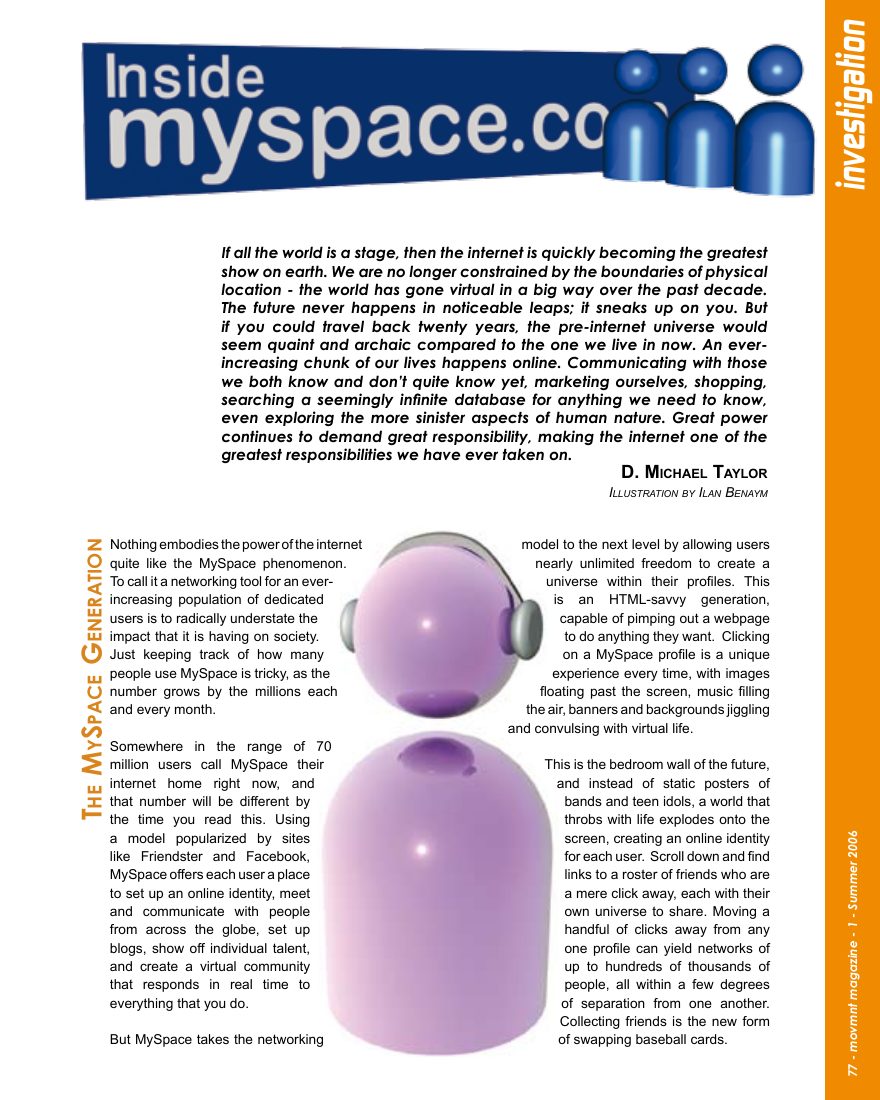
investigation If all the world is a stage, then the internet is quickly becoming the greatest show on earth. We are no longer constrained by the boundaries of physical location - the world has gone virtual in a big way over the past decade. The future never happens in noticeable leaps; it sneaks up on you. But if you could travel back twenty years, the pre-internet universe would seem quaint and archaic compared to the one we live in now. An everincreasing chunk of our lives happens online. Communicating with those we both know and don’t quite know yet, marketing ourselves, shopping, searching a seemingly infinite database for anything we need to know, even exploring the more sinister aspects of human nature. Great power continues to demand great responsibility, making the internet one of the greatest responsibilities we have ever taken on.
Illustration by Ilan Benaym
Somewhere in the range of 70 million users call MySpace their internet home right now, and that number will be different by the time you read this. Using a model popularized by sites like Friendster and Facebook, MySpace offers each user a place to set up an online identity, meet and communicate with people from across the globe, set up blogs, show off individual talent, and create a virtual community that responds in real time to everything that you do. But MySpace takes the networking
model to the next level by allowing users
nearly unlimited freedom to create a universe within their profiles. This is an HTML-savvy generation, capable of pimping out a webpage to do anything they want. Clicking on a MySpace profile is a unique experience every time, with images floating past the screen, music filling the air, banners and backgrounds jiggling and convulsing with virtual life. This is the bedroom wall of the future, and instead of static posters of bands and teen idols, a world that throbs with life explodes onto the screen, creating an online identity for each user. Scroll down and find links to a roster of friends who are a mere click away, each with their own universe to share. Moving a handful of clicks away from any one profile can yield networks of up to hundreds of thousands of people, all within a few degrees of separation from one another. Collecting friends is the new form of swapping baseball cards.
Nothing embodies the power of the internet quite like the MySpace phenomenon. To call it a networking tool for an everincreasing population of dedicated users is to radically understate the impact that it is having on society. Just keeping track of how many people use MySpace is tricky, as the number grows by the millions each and every month.
New York, NEW YORK United States
More established artists have caught on as well, using MySpace as a platform to launch their albums, provide sneak peeks into their upcoming projects, and tap into the seemingly endless supply of young trendsetting music-lovers who inhabit the MySpace world. Acts like Weezer, Nine Inch Nails, Depeche Mode, Black Eyed Peas, and even Neil Diamond have all launched albums on the site. Madonna marketed her Confessions on a Dance Floor album by releasing exclusive personal “confessions” through her MySpace presence. Death Cab for Cutie, representing the emerging “indie” or “emo” trend in youth culture, premieres singles through MySpace. The logic behind it is simple – where else are you going to find almost 100 million connected kids who all communicate with one another and broadcast their likes, dislikes, and desires in one easy to use platform? It is a marketing nirvana.
More than 700,000 artists and bands use MySpace to market themselves, filling a void that was left when file sharing altered the way we find and explore music, crippling the traditional music industry. Marketing your band used to take years of playing dives and coffeehouses, hoping to be discovered by a major label. Even truly talented artists were simply needles in a haystack that rarely got noticed. The organic communities that spring up around MySpace artists create a form of guerilla marketing that can catapult unknowns into the spotlight in a matter of months instead. The haystack is bigger and the marketplace much more crowded, but true talent tends to break through the clutter and noise to get noticed more quickly. Think of it as a type of PR engine. There are MySpacers with tens of thousands of friends connected to their profiles who act as conduits for up-and-coming talent.
Home | Browse | Search | Invite | Film | Mail | Blog | Favorites | Forum | Groups | Events | Videos | Music | Classifieds
Created three years ago by Tom Anderson and Chris DeWolfe, MySpace was originally a scrappy, organic networking forum that seemed to create a purely democratic community of users. Every new MySpace profile already contains the ubiquitous image of “Tom”, with an actual picture of Tom Anderson sitting at his computer, looking every bit the internet nerd. His is probably the most widely known internet profile in the world at this point. But behind this seemingly grassroots image lies the public relations behemoth Edelman, which carefully cultivates this populist image of the MySpace world, leveraging the word-of-mouth potential for advertisers who are increasingly budgeting more and more to explore this emerging form of advertising. The Edelman website yields marketing presentations that detail how MySpace can integrate your product into the profiles of thousands of well-known artists or MySpace personalities. The era of static print ads and thirty-second television spots is being challenged by a more nebulous form of advertising that attempts to integrate itself into the fabric of your online experience without being quite as obvious about it. The effectiveness of this type of marketing is much more difficult to track, but we live in a TiVo world where ads are much easier to tune out as we become the digital creators of our own unique media experience. Finding ways to incorporate the messages of powerful advertisers who are being lost in the mix is essential at this point. Google managed to make the online advertising landscape profitable recently with computergenerated ads for blogs and websites.
Take Brownie for instance. Born Brian O’Donnell, Brownie has been making music and playing the bar/coffeehouse scene for over a decade, languishing in relative obscurity like most singers living in New York. Last year he started a MySpace profile, and was discovered by an evergrowing community of young music fans that are currently obsessed with his brand of melancholy indie pop. He currently has over twelve thousand friends on his profile. He has hired a small PR firm to do nothing more than help him manage friend requests and comments. He is about to release an anticipated full-length album in October, and is planning a national tour where the only coffeehouses he will see will actually be serving him coffee. He is also thinking of touring Europe. All of this happened in less than one year.
Now that MySpace has gone corporate, it is already planning to extend the brand in unique ways, leveraging the power of this online juggernaut. Not only will you hear MySpace mentioned in every third conversation on the street, you will soon start seeing it on cell phones, PDAs, and even television, as they have recently started farming out original user-generated content to interested networks. It’s a YouTube world now, and we’re all slated for 15 seconds of fame.
Rupert Murdoch’s News Corp. recognized the powerful potential of such a phenomenon and purchased MySpace a year ago for $580 million. Fox News, also owned by News Corp., recently ran a piece about a Columbine-style plot by some young students in Kansas that was thwarted by authorities when someone tipped them off that they had seen some disturbing info on MySpace about the plan. This was a nice change of pace from the usual stories of young girls being seduced and even killed by older MySpace lurkers. News Corp. has a keen interest in blunting the criticism that keeps getting louder as the era of internet predators becomes more of a media circus.
Yahoo, Microsoft and AOL are scrambling to get their hands into the half a trillion dollar cookie jar that online advertising now represents. But MySpace is where the limits of that marketing potential are being revolutionized in real time. The roster of advertising heavyweights that make up some of the MySpace universe already includes Honda, Wendy’s, Toyota, and Cingular Wireless. Not only do they get ubiquitous profile integration, but the real sweet spot of the MySpace ad buy is the instantaneous buyer feedback into the wants and needs of the most desirable demographic population in the universe. People are willing to pay big bucks to get their hands on that kind of reliable feedback.
movmnt’s Friend Space : movmnt has countless friends
View All of My Friends
In February of 2006, police were actively investigating as many as seven assault cases related to MySpace in the Boston area. A police sergeant described the site as a “predator’s dream come true.” One man traveled over one thousand miles to meet a young girl from Connecticut. Parents are understandably nervous about this new phenomenon. Their young kids are signing on, faking their age (99 seems very popular with the under-18 crowd for some reason), and making thousands of new friends who may or may not be what they claim to be every time. Here’s the tricky part, some of these kids actually do know they are dealing with much older friends and are consensually meeting with them anyway. It blurs the line of what we think of when we think of molestation, but remains downright horrifying to parents, nonetheless.
Pesach Lattin, the man who invented the annoyance of popup ads strangely enough, wrote a piece describing his experience looking for inappropriate behavior on MySpace, and came to the conclusion that, “MySpace is a buffet for any pervert looking for easy targets.” He found “private” groups that are theoretically monitored filled with a cornucopia of ageinappropriate activity, including one for young girls to meet older women. Regulating this type of activity will be tantamount to regulating the internet itself, a task pretty much deemed impossible by most. MySpace has tightened its monitoring practices, but in
MySpace is here to stay, obviously. It has achieved a critical cultural mass in just a few years that makes even Google look slow by comparison. There is a legion of copycats on the horizon about to inundate the market with every conceivable niche network you can imagine, hoping to strike the same gold that MySpace has found. Very few will actually succeed, but enough will to ensure that almost every internet junkie in the world will be a part of the phenomenon somehow, and soon. Networking sites will continue to change the way that we market our bands, our art, our lives, and ourselves. They will also continue to reformulate how advertisers approach the marketplace, with tools that will become more and more sophisticated and integrated into our lives. They will, in short, change how we approach the world, granting us the power to communicate with the global community in ways that will make the current incarnation of the internet look as quaint as a pen and paper do to us now.
Is this a good or a bad thing in the end? It’s probably a bit quaint to think in these sorts of binary terms about MySpace as well. The powerful tools that we create to communicate with one another are rather neutral constructs. Who could have foreseen the ways in which the printing press would change the world, making it smaller, easier to understand, more democratic? But the written word itself is also a double-edged sword, and in the wrong hands has been used to create fascist states, start wars, and stoke the fires of human strife. Wishing this kind of power away only makes one despondent and irrelevant. The only way to approach a new communications paradigm is to embrace it, looking for the ways that it can help us, and others, become better, more developed human beings.
the end, the power of internet networking works the same way for everyone, even those who have less than noble intentions. MySpace is merely the most visible example of this sort of problem, however; you may as well blame it on cars when strange men cruise by a playground with their window rolled down to pick up children with the offer of a lollipop. Society will have to learn how to cope with these issues online, just as it has had to learn to be more vigilant with their children in the real world over the past several decades.
Get 4 issues and Moving Still, the book FASHION DANCE MUSIC SOCIETY
US: $5.95 CAN: $6.95 for only $20* instead of $49 SUBSCRIBE AND SAVE!
Name Address City / State / Zip / Country E-Mail Address Make Checks payable to: movmnt - e-maprod, 50 Pine Street, 9N - New York, NY 10005 United States: 4 issues......$20 *Canada: 4 issues......$30 *International:......$40 Or subscribe online at www.movmnt.com magazine
Send me 4 issues of movmnt for only $20 and i’ll receive a free copy of Moving Still (*Offer Valid only for the United States)
FASHION an e xclusive look at photographer james houston ’ s new book competition dancers in the hottest athleticwear
BAD BOY a conversation with rasta thomas on newsstands october 2006