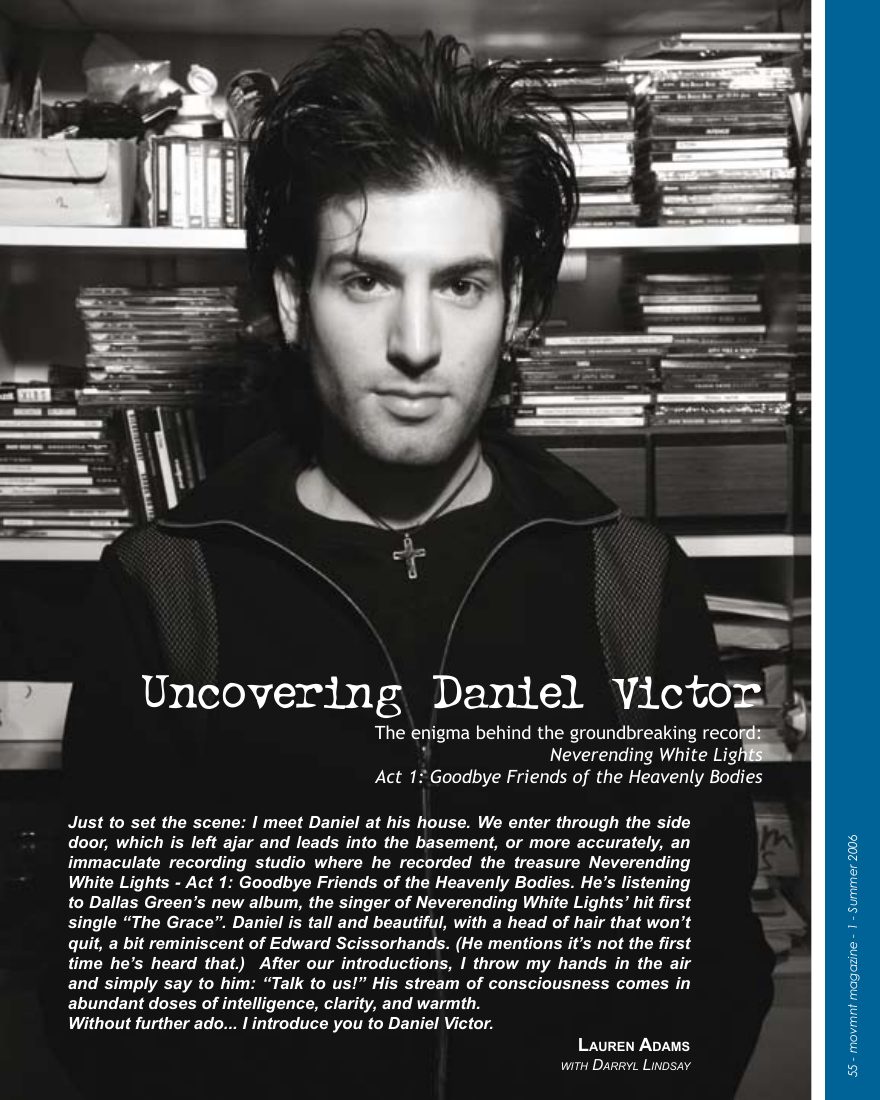
Uncovering Daniel Victor Just to set the scene: I meet Daniel at his house. We enter through the side door, which is left ajar and leads into the basement, or more accurately, an immaculate recording studio where he recorded the treasure Neverending White Lights - Act 1: Goodbye Friends of the Heavenly Bodies. He’s listening to Dallas Green’s new album, the singer of Neverending White Lights’ hit first single “The Grace”. Daniel is tall and beautiful, with a head of hair that won’t quit, a bit reminiscent of Edward Scissorhands. (He mentions it’s not the first time he’s heard that.) After our introductions, I throw my hands in the air and simply say to him: “Talk to us!” His stream of consciousness comes in abundant doses of intelligence, clarity, and warmth. Without further ado... I introduce you to Daniel Victor.
Lauren Adams with Darryl Lindsay
The enigma behind the groundbreaking record: Neverending White Lights Act 1: Goodbye Friends of the Heavenly Bodies
“I do find comfort in the thought of believing in angels” “I was born and raised in Windsor (Ontario, Canada). My dad was a musician. I was raised in a studio. This was supposed to be where my toys were. I’m supposed to come downstairs and play with my friends, but there are drums and guitars and people smoking weed and making records. So I had kind of a different upbringing in that sense. My friends always wanted to come over just to watch. So we’d hide out in the dark and listen while people recorded their vocal tracks and we thought it was the coolest thing. I was doing mixes and recordings when I was about six years old. I would sit on my dad’s lap at the board and play with the faders. He’d let me do my own versions of the songs they were recording. I was already developing my sense of production and engineering.
My dad stuck me on a piano when I was five. I was taught by nuns; they were really strict. I remember once we were allowed to bring in one piece that wasn’t classical, a pop piece, and I brought in “When Doves Cry” by Prince and they flipped out saying, ‘You can’t bring this in here!’ I actually ended up quitting piano when I was old enough to have my own say, but I’m glad I did take lessons because piano is the foundation of any instrument. My first band might have been when I was eleven years old, just fooling around with my friends. When you get to high school you can start taking music a little more seriously. Right away I got involved in the music department. I was a drummer and I ended up learning how to play the guitar. I graduated and just wanted to start making my first record, right out of high school. Instead, my mother said, ‘You have to go to university and get your degree.’” Neverending White Lights is the album Daniel had wanted to make. On the album, Daniel collaborates with fifteen different artists, among them Nick Hexum from 311, Raine Maida of Our Lady Peace, and Dallas Green aka City and Colour. Daniel remarks, “In ‘The Grace’, I think that Dallas brings that song to life and I wrote it with that in mind, because I can’t sing those parts like he can sing those parts. Along the way I found the right combination of song and singer. I came up with that whole concept and that’s kinda when it all started. At first I wasn’t sure how far I’d be able to take it, but I never doubted myself. I just thought I’ll take it a day at a time and see what happens.” So for the burning question: How did he get the artists to work with him having no track record? He had never released a record, been in a video, or toured with a band. Some of these guys are veterans; some of them are legends. Why would they want to work with him? His response: “There’s only one answer and it’s the simplest answer: they liked the music. The music spoke for itself end of story. That was it, and every call I got back was ‘I love this song, I want to do it.’ “I was doing a lot of reading about worldviews and religion and they started making their way into all the lyrics. Then there’s this whole angel theme going on - the record is called Goodbye Friends of the Heavenly Bodies. I do find comfort in the thought of believing in angels. I think that it’s something that’s dying. It seems like people don’t really believe in the things that they believed in a really long time ago. So I wanted to make a record that was saying goodbye to these beings. In a similar sense, the title Neverending White Lights is a take on life in the sense that when we die, we leave our bodies behind, and then our spirit moves into the next life like a light. I always say like a light that doesn’t go out or a light that never ends - a neverending white light. I think that’s why people find something here; it’s deeply rooted in my soul. It’s very personal and genuine. When speaking about his first single, “The Grace,” he says, “As it started to get radio play across the country, it just struck a chord with people. It started to grow and
The Missing Link In the CD, Daniel thanks “all the artists involved [for their] patience and willingness to contribute [their] wonderful talent.” First on the list is Jonathan Foreman, to whom he writes, “We can feel the ‘letdown’ from here.” That’s a reference to Switchfoot’s 2003 album, The Beautiful Letdown, which features the track “On Fire,” a collaboration between both artists. It was the first song written for NWL. Switchfoot recorded it, and the album went double platinum. Daniel was able to live off of the royalties for five years, allowing him to focus solely on NWL and complete the album. It was a fait accompli that came right at the beginning - one he’s grateful to for “keeping him alive.” To replace the song on Act 1, they wrote “Throwing Chairs.” Unfortunately, last spring, Daniel got a call from Switchfoot’s management informing him that he would not be able to use the song on NWL’s record, as it timed too closely to the latest Switchfoot release. Daniel argues, “It’s not even the same genre of music! They thought that maybe it would compete with their release. It’s completely sickening. I haven’t spoken to Jon in a really long time, since everything happened.” You don’t miss the song on the album, but those who have heard “Throwing Chairs” are praying for a truce! Pehaps then we can look forward to a NWL B-sides album.
grow and grow, and people started to buy the record. I started getting emails and people finally started telling me what they thought about my music. That was when I realized, someone in Halifax is listening to my record. And that’s when I had to get comfortable with affecting people.” Daniel recalls his favorite part of working on the video for “The Grace” was working with Emm Gryner, whom he had idolized growing up. She plays an angel. As her dress is unzipped, two scars are revealed. Daniel sews her wings in place so she can go to heaven. Without her he dies, and in the final scene she comes back to him only to find it’s too late. The final shot mirrors the artwork of the album cover, which is an old Red Cross advertisement Daniel found somewhere in Italy.
Not being in a set band has opened up his world of opportunity. “I can take this wherever I want and I really don’t have to answer to anybody.” He says the next album will be a whole new group of artists. “I’m actually leaning towards a few Canadian artists. One of them is Rufus Wainwright. I didn’t feel like I would’ve been able to approach him, that’s how much respect I have for his work. Also my favorite lyricist of all time, his name is Matthew Good, in a band called The Matthew Good Band. I just think he’s a genius. His lyrics blow my mind.” When asked who his influences are, Daniel responds, “Earlier on I was really inspired by Tori Amos. Her record Under The Pink changed my life. It made me feel very emotional about music. That album gave music a lot of meaning. I realized there’s a lot of power here. It can affect you like nothing else can. It’s just chords and melodies, it’s just notes, and it’s just the way your ear hears it and the way your brain perceives the sounds, but it gets emotion. And that record turned me onto feeling sad in a happy way, where it’s not necessarily a bad thing to feel emotional or sad. It reminds you that you’re alive. Happiness is great, but happiness is never happiness unless you know what sadness is. You always gotta have that contrast.“
“and then our spirit moves into the next life like a light, and I always say like a light that doesn’t go out or a light that never ends - a neverending white light.” He continues, “Part of the idea of Neverending White Lights was to collect all of your favorite sad songs and all of the slow songs of your favorite albums and make one record of all of them. If you listen to this record from track 1 to 16, I find it emotionaly draining,” says Daniel. It was a trying journey. “I bled for this one.” Daniel recently recorded a solo album with a projected release later this year. As I hug him goodbye, I am awakened by his last words: “It’s time to change music, change the world.”