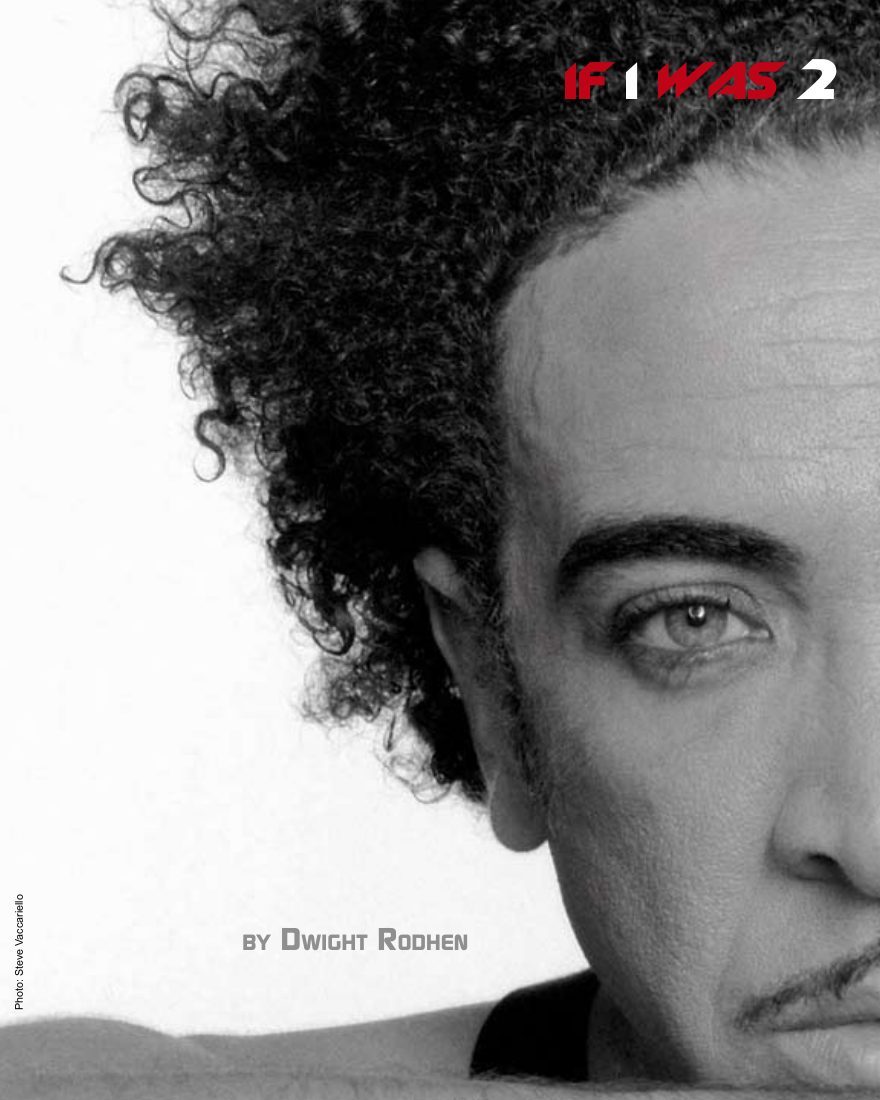
Photo: Steve Vaccariello if i was 2 by Dwight Rodhen
The uncanny impulse to imagine simply drives one to dream. Have you ever had a storm of ideas invade your consciousness? Their relentless drive wiggles and squirms into a form that rears its pretty little head when you least expect it. They kick and whirl about in your brain, and have been known to deprive you of those much needed eight hours of shuteye. These self-proclaimed pioneering thoughts can puzzle and confuse, yet push and motivate. They sometimes won’t leave you alone until you give them a platform and a spotlight to be realized. When the thrill of unsatisfied potential and what is yet to be has you all fired up, and the fascination with invention is an inevitable open road to that utopian paradise of creativity… it is at this point that you must know you’ve been bitten by the bug. Needless to say, and in my case specifically, the “choreography” bug. I have to say, my system has been profoundly and permanently compromised by the joy of movement. This makes me a long-time survivor of a serious malady, and at present I am symptomatically having an intense romance with the creative process. With an uncontrollable obsession before me, I’m looking for someone to take responsibility for my condition. I warn you, this “condition” could be infectious, but I hear these days it’s all the rage.
If I was to point fingers, and I will - I’d have to blame my mother whose infatuation with the “new” had our family relocating almost as many times as you close fifth position at the barre in ballet class. Whether we were moving sprawling ultramodern condo by the mall, this middle class, middle child of five was caught in a tornado of everchanging decors, renovations, and color schemes, not to mention social circles and neighborhoods. The
I believe that directors and choreographers must create a secure setting for artists to be comfortable with being uncomfortable from the cramped ranch in the ghetto to that three-story English Tudor in the suburbs, where I could attend the fully integrated Catholic Academy, or to the cascade of ever-changing atmospheres kept a resilient wandering imagination occupied with a kaleidoscope of environments to dream and make believe in. And while I’m playing the blame game, that eccentric grandmother of mine wasn’t much better (with her mix of fine antiques and more knick-knacks than I could playfully swing a baseball bat at and break in a single weekend visit), always either parked at the piano fingering out a prelude from Chopin, preparing veal, learning the latest dances, or discussing ad nauseam the complexity of the face of an oak leaf. She taught all that would listen how to capture a glimpse of the moon while on a casual stroll in the park, to marvel at the beauty of the infinite sky. Viewing life from this perspective lent hope for an impetuous kid to find his way in an overly stimulating, ever so exciting world - a world that seemed as though change was imminent, and anything was possible as long as you dreamed big and were committed. Now, if this sounds a bit like you’re in an episode of Oprah’s dream catchers or in a scene with Glinda the Good Witch from The Wizard of Oz, and it does – then perhaps the notion that life is a perpetual creative process isn’t so far-fetched after all. Being creative is how we go through our daily lives – setting a plan in place, composing our day so that we accomplish things within a set window of time. Time and space often become the parameters that frame creations. Inspiration and the need to say and/or accomplish something furnish the incentive to complete the task at hand. Ideally in an hourand-a-half dance class, the instructor guides students through a series of exercises that prepare the body piece by piece to conquer anything that comes his or her way in the choreographic process. It’s about setting priorities, sequencing events, and being skillful and crafty in rendering a plan. So, does carrying out a creative task require some level of technique and planning in order to realize it fully in an efficient and economical way? I think it does. It requires a desire and a plan to get from A to B, and then from B to Z. It’s all relative and comes down to style and preference. We live in a world of extremism where we talk on the cell phone, send an email, and text a buddy, all while cooking breakfast. Today’s dancers are incredible athletic specimens; their abilities seem to supersede what seems reasonably fathomable. They have eight pirouettes in their back pocket, and pyrotechnics is the norm. The joy for me these days is not to see a dancer jump higher, or do the next big trick, but to help them realize the power of their gifts, the impact of a simple gesture, and the amazing responsibility that they have to this formidable art form. I believe that directors and choreographers must create a secure setting for artists to be comfortable with being uncomfortable. We must allow ourselves to risk it all, if we expect the same from our artists. This is the only way I feel we will continue to push the form. And we must push the form, or what is the point? I’ve been called a “dancer’s choreographer,” and I relish that idea. Making dances today requires a fresh yet fundamental approach, a need to say something, and the ability to articulate it to your dancers so that they can breathe life into it. I tell dancers there really are no new steps, just new approaches and points of view. For me, a great process starts with a great relationship with the dancer. Great choreography comes out of a choreographer’s ability to inspire and empower an artist to discover. The other part of that equation is, of course, having the craft to assemble an idea with purpose, to engage your audience, and speak clearly of your concept. I often find myself searching for the most concise way to convey what I want in a new work – it’s actually a process within a process. Being in sync with that progression as a new work is being born, witnessing the achievements and missteps along the way, is a delicate yet insightful vantage point to observe an artist’s transformation. Choreographers sometimes have the job of being the proverbial cheerleader, one who helps the dancer take that challenging next step and keeps the creative party flowing. He or she becomes that they play a vital role in the end result. Here again is where communication is key. People always ask – where does one start when making a ballet? What comes first? The whole chicken or the egg analogy. Who knows? Who cares. I start with where I want to go, and then go back and figure out how I’m going to get there. For me, this is where the fun comes in. Creativity starts with imagination, a vision or dream, an ability to see something that is not yet there. In other words, possibilities - that array of options or choices. A selection of courses of action and alternatives. It’s a colorful world we live in. Our minds are fertile ground for beginnings, and our hearts are the endless lifeline of tenacity. And our souls? Well, the soul brings the passion and the pulse to our life and work. This is the indisputable originality to what we create. It’s much like the DNA of our own ingenuity. The magic of the creative process after all is said and done really eludes all of us, if we are honest. In fact, while writing this article I composed drafts in various orders. This is one of many versions. How many can you come up with? So many, that if I continued to explore every possibility, this
Creativity starts with imagination, a vision or dream, an ability to see something that is not yet there the canvas keeper, being sure that the paints, in all their brilliance, don’t dry up before they reach the canvas. Trust is paramount between dancer and choreographer, and it’s important for the artist to be a willing participant, and know article would have never made the deadline. Like I said, much happens by chance, individual notions of time and space, grandma’s knick-knacks, the Dalai Lama, and just maybe where the moon is.